YouTube
Why Communication Matters and the Seminar Promise
4 min · 1 question
Preview
Gurujada
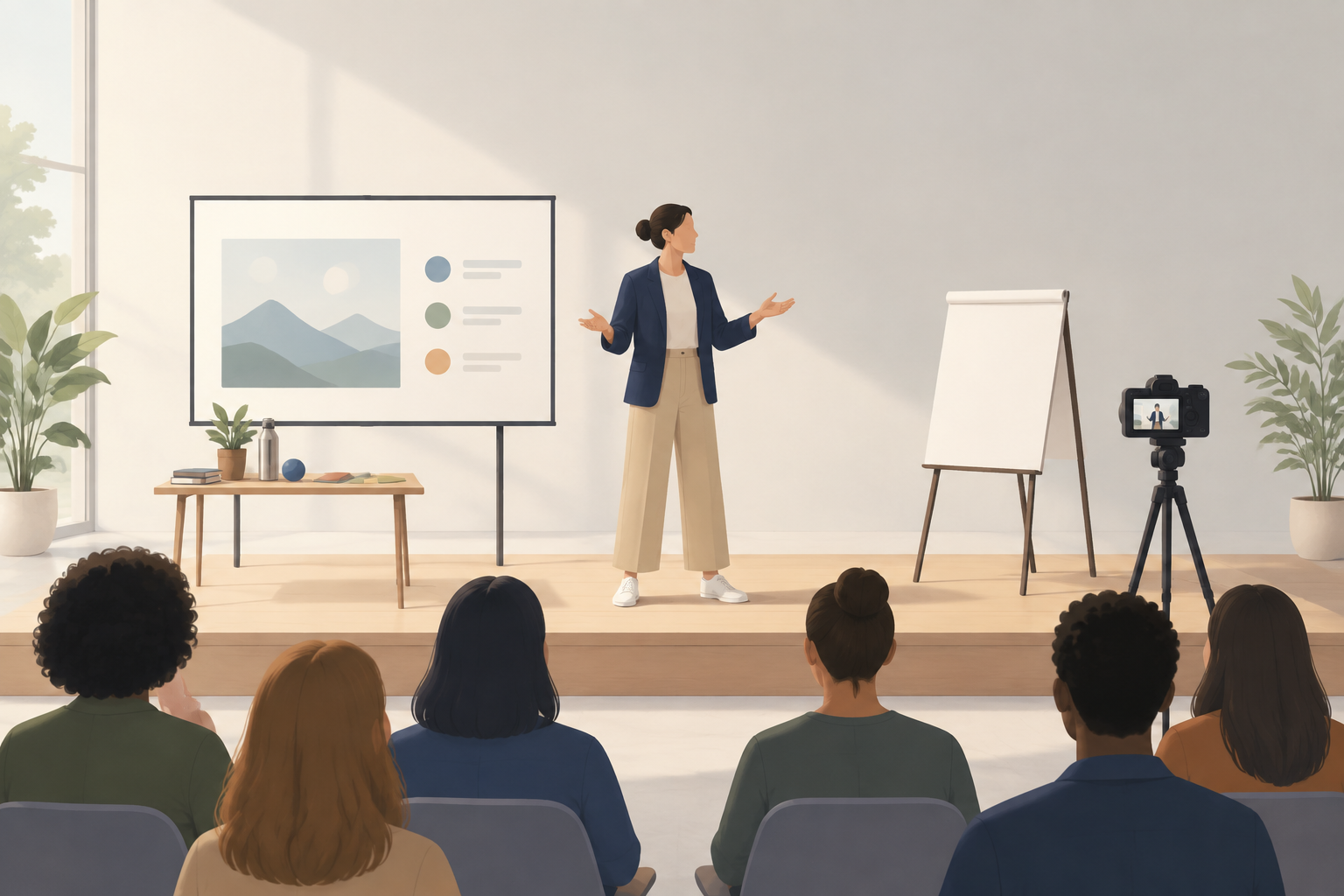
Give talks people remember: open with a promise, use the board and props well, avoid the slide crimes, and finish with a salute.
 K
With Krishnamohan
From Patrick Winston, MIT OpenCourseWare · CC BY-NC-SA 4.0
K
With Krishnamohan
From Patrick Winston, MIT OpenCourseWare · CC BY-NC-SA 4.0
Explain why speaking, writing, and idea quality—in that order—determine career success.
Choose a board instead of slides when the purpose is informing, teaching, or lecturing, and slides when exposing an audience to something.
Distinguish exposing an idea from teaching it.
Structure an informing talk by starting with a promise.
Choose an appropriate final slide and explain why it works.
State the communication-quality formula (K + P + T) and justify why knowledge and practice outweigh inherent talent.
State why board writing speed matches how quickly people can absorb ideas, unlike flipping through slides.
Name the two slide faults Winston says are always true without seeing the deck.
Identify the three sources of inspiration found in Winston's survey and use them in teaching.
Explain why collaborator lists, conclusions, questions, and blank slides are poor endings.
Use the Mary Lou Retton skiing story to argue that practice and knowledge beat raw talent.
Use the board as a target so nervous speakers have something purposeful to do with their hands.
Explain why too many slides and too many words weaken a job talk.
Design an opening that shows why a topic is exciting using a concrete, illustrated example.
Label the closing slide as contributions.
Explain why jokes tend to fall flat at the start of a talk
Explain how a physical prop can carry narrative tension and memory (Ibsen's stove and manuscript).
List common slide mistakes (reading text aloud, too many words, split attention, small fonts) and identify their corresponding fixes.
Explain why teaching thinking can be reframed as teaching storytelling skills.
Judge whether to end a talk with a joke, a thank you, or a benediction.
Describe what an empowerment promise is and why it works
Describe Papert's spinning bicycle wheel demonstration and why engineers using the right-hand rule fail about half the time.
Explain why wordy slides cause an audience to stop listening, citing the one-language-processor idea and the recall experiment.
List the five components of a story-based approach to teaching thinking.
 4 min
Preview lesson
Why Communication Matters and the Seminar Promise
The video stops to ask you a question
4 min
Preview lesson
Why Communication Matters and the Seminar Promise
The video stops to ask you a question
You are opening a 45-minute workshop for a local gardening club on how to compost safely at home. Write the opening two or three sentences you would say, starting with an empowerment promise that tells the audience what they will know by the end that they don't know now.
4 min · 1 question
2 min
5 min · 1 question
4 min · 1 question
6 min · 2 questions
4 min · 1 question
4 min · 1 question
2 min
2 min
4 min · 3 questions
2 min
4 min
5 min
3 min
5 min · 5 questions
4 min
2 min
3 min · 1 question
5 min
5 min · 1 question
6 min · 3 questions
4 min · 1 question
6 min · 1 question
2 min
5 min · 4 questions
6 min
Patrick Winston's MIT lecture "How to Speak" as short video lessons with practice: how to start a talk, use boards, props and slides, inform and persuade, and stop. Lecture by Patrick Winston, MIT OpenCourseWare, CC BY-NC-SA 4.0; this Workbook is shared under the same license.
K
Krishnamohan
Also teaches Beyond LeetCode · Lendi · Oct 2026 , Multiply near 100
Patrick Winston, MIT OpenCourseWare · CC BY-NC-SA 4.0
Anyone can join
JoinWe can't find the internet
Attempting to reconnect
Something went wrong!
Attempting to reconnect